


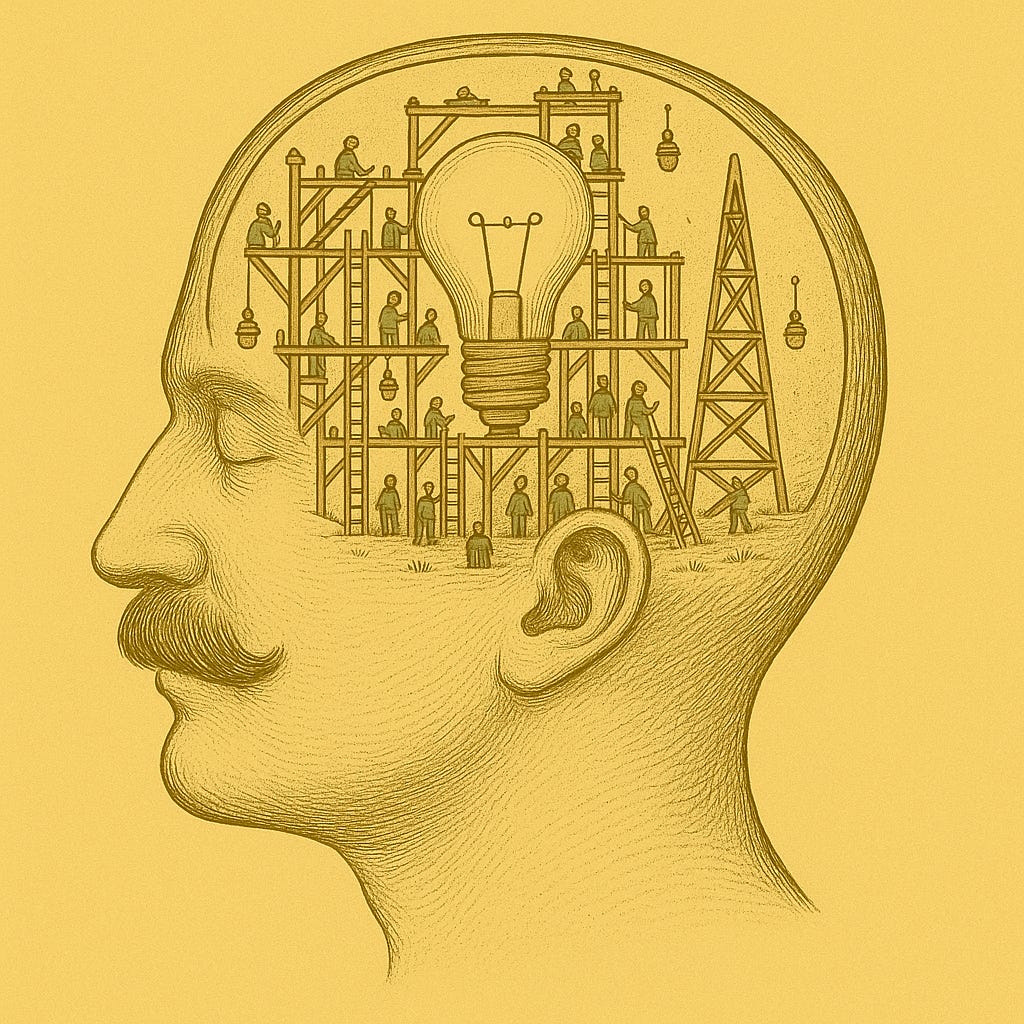
Walking into a Vegas casino— the air is thick with recycled oxygen; the walls are coated in a gold-crusted laminate. No clocks, no windows— the space weighs heavy, like a lurid, grizzled sanitarium. Just a few feet in, beyond the hard-lit sheen of it all, the first people you notice are the slot machine jockeys. Their faces are slack, mouths slightly open, as they jab at the buttons with a kind of moronic certainty. The shrill carnival of light and sound is both deafening and ignorable; a perfect background noise for people who don’t want to think anymore. Caesar’s Palace, Mandalay Bay, The Bellagio— they offer a peculiar kind of sanctuary, where intention, consequence and self-awareness dissolve into the endless, repetitive hum of excitation; making everything ordinary too beautiful to bear.
According to the American Time Use Survey, conducted by the U.S. Bureau of Labor Statistics, Americans currently enjoy more leisure time than at any point in history; yet 83% of us report spending none of this time whatsoever “relaxing or thinking”. Instead, we are trapped in a casino of likes, retweets and dopamine-soaked drudgery— consuming content so hyper-stimulating that relaxing is impossible and thinking is unnecessary. The average American, today, spends 6 hours awake “consuming content”, checks their phone 205 times a day (once every five minutes) and lives in a house with 17 internet-connected screens. More of us have a Facebook than a primary physician; more have easier access to WiFi than clean air; and more have the ability to order UberEats than to microwave a meal.
The rhythm of American life has become twitchy, impulsive, allergic to lag— demanding one-click purchases, same-day shipping and fast-lane checkouts. Our decisions are made mid-scroll, our interactions unfold in push notifications, and our enterprise—well, one ad campaign said it best: “Instant gratification just got faster. Shop Vogue-dot-com.”
We’ve grown so intolerant of delay that we can’t sit through a full microwave countdown before intervening— preferring to eat it lukewarm than wait for zero. We don’t read, we skim. We don’t date, we match. According to data from Spotify, listeners skip 24% of songs within the first five seconds and 49% of songs before they end. On TikTok, meanwhile, users decide if the video is worth their time within 3 seconds of viewing; and if it doesn’t load within two— on to the next. Following suit, Hollywood writing rooms have been instructed to keep all scenes under five pages (i.e. five minutes) and to never let a character speak more than five lines uninterrupted. Yet still, 94% of us make sure to keep our smartphones on hand just in case the next scene can’t hold off the itch to scroll.
Silicon Valley has unleashed a line of products (i.e. the iphone, social media, streaming platforms, etc.) so efficient at delivering pleasure that all else feels gray, drab and not worth it. The baseline of stimulation has been raised so high that— anhedonia, a psychological condition best defined as chronic joylessness or an inability to experience the beauty of ordinary life, is increasingly being diagnosed in those of us who are most immersed in these god-like technologies.
New York Times columnist David Brooks calls it “The Junkification of American Life”— a diet full of flavor and void of nutrients. A culture that feels like it’s limping forward; “stale”, “stuck” and “unmotivated”— Google search terms that have all increased by at least 200% in the last two decades. We are numbed-out, overstimulated into indifference and underwhelmed by everything.
Some have labeled it more simply— a crisis of boredom. We are a nation where half the workforce says they are bored with their jobs (69% if measured by ‘feeling engaged’), close to 40% of all of us claim to be bored with our social lives and two-thirds of millennials report being plainly “bored with life”. According to research, young Americans today are more “boredom-prone” than at any time in history— so much so that Gen Z has been crowned the ‘the bored generation’. And for many, the feeling is a strange kind of exhaustion where more than half our day is spent sitting, and yet we feel tired— tired of work, tired of leisure, tired of a culture so fried with cynicism and unseriousness and pointlessness.
But the crisis is misdiagnosed. The opinion that work sucks or that there’s nothing good on Netflix is not boredom. It is frustration, it is aggravation, it is restless dissatisfaction, it is the sober weight of unmet expectation. It is all these things and more; but above all, it is the mistake of defining boredom by what it makes us feel instead of by what it is. Diagnosing the symptoms as the illness— mistaking the fever for the infection.
Americans today feel more anxious, more adrift and more unhappy. We are also— never bored.
Definitions of Boredom
In 1933, the novelist James Norman Hall wrote a letter to the Concise Oxford English Dictionary. Defining boredom as “being bored; ennui.”, Hall explained that, “To define [boredom] merely as ‘being bored,’ appallingly true though this may be, is only to aggravate the misery of the sufferer who, as a last desperate resource, has gone to the dictionary for enlightenment as to the nature of his complaint”.
Boredom, throughout history, has stubbornly resisted a precise definition, wriggling through the cultural lexicon like a greased pig, evading philosophers, scientists and linguists alike. It is a word that means both too much and too little— the kind of concept that everyone assumes they understand until it comes time to explain it. Some have defined it as a lack of external stimulation, others as a kind of emotional recession and still others as the leaden stupor of a mind unable to decide what it wants. It has been called a symptom of modernity, a biological alarm system, a spiritual sickness, a privilege and a curse. It drifts between the trivial and the profound; the universal and the personal; as likely to strike in a fluorescent-lit waiting room as in a velvet-roped champagne room. As the psychologist Adam Phillips put it,
“[W]e should speak not of boredom, but of the boredoms, because the notion itself includes a multiplicity of moods and feelings that resist analysis; and this, we can say, is integral to the function of boredom as a kind of blank condensation of psychic life”
Broadly speaking, however, boredom is usually thought of in one of two ways. The first is as a deficit of meaning— a sense of purposelessness and existential disinterest. The second is as a deficit of attention— a state where the mind is unoccupied and without focus. The first, what may be called ‘cultural boredom’, is abstract, less urgent, and entirely man-made— an unintended byproduct of natural selection’s misalignment with modern life. The second, what may be called ‘biological boredom’, is much older and more primal— an evolutionary function woven into the logic of selection and shared across species. In short, there is boredom as defined by nature and boredom as defined by humans.
But perhaps the more useful distinction is between feeling bored and being bored. Like the difference between feeling alone and being alone; one is a psychological state and the other is a material circumstance. One a measure of subjective experience, the other a measure of objective conditions. What this means is that feeling bored is self-reported— you can only know if someone feels bored by asking them. But to know if they are bored, you don’t need words— you need observation: brain scans, environmental situations, introspective awareness, etc.
Of all the available measures, arguably the most comprehensive marker of being bored is the activation of what neuroscientists call the brain’s ‘default mode network’. The default mode network describes a network of brain regions that are more active when an individual is not focused on the outside world and is instead engaged in internal thoughts, daydreaming, self-reflection, or other forms of “mind-wandering”. Put simply, it is the brain alone with nothing but its own thoughts.
In the most absolute terms, being bored is the condition of nothingness. It is not something felt but something endured; not a disturbance but an absence. It is the blank space behind every human experience; the raw foundation of existence before feeling or meaning is imposed. Being bored is not just a pause in the dopamine drip, but the void into which thought, desire, and distraction rush to take shape. It is not merely the opposite of stimulation— it is the state from which all stimulation is an escape. There is boredom, and from it, everything else grows.
Being bored is the ground floor— the bare, stimulus-poor reality before the mind knows what to do with itself. Biological boredom, then, is conscious experience’s most primitive reflex in response to this nothingness.
Biological Boredom
‘And Alexander wept, as he had no more worlds to conquer’.
It is perhaps evolution’s strongest and most universal selection pressure—what the Buddhists call “dukkha”—and what in the West best translates as “unsatisfactoriness”. In their book, “Out of My Skull: The Psychology of Boredom,” neuroscientist James Danckert and psychologist John Eastwood describe it as a feeling similar to tip-of-the-tongue syndrome— a kind of nagging sensation that something is missing, though we can’t quite say what. Always almost; it is living with the frustration that what is is never as good as what could be. Because to be rewarded for wanting more—more stuff, more status, more sex—instead of for having enough, describes life’s most fundamental adaptive strategy. Across species, individuals who are happy with less than the greediest amongst us are outcompeted, out-reproduced, and ultimately erased from the gene pool. Enough is never enough— because too many successful copies is an impossible error.
But wanting more is only half the equation. Our thirst isn’t just for accumulation, but for variety. The same old thing, no matter how pleasurable, is rarely as tempting as a new thing. A full stomach isn’t enough— we want a new flavor. It is what biologists call “novelty-seeking” behavior— the tendency to explore and engage with new stimuli in the environment. As Darwin put it in 1859,
“It is in human nature to value any novelty, however slight”
Chasing newness leads organisms to discover greater sources of food, water and other vital resources. And in a world of shifting climates, changing ecologies, and constant competition, those willing to try new behaviors or adapt to new habitats often have the advantage. Attunement to the unfamiliar also sharpens an organism’s ability to detect threats early, increasing the odds of escape before it’s too late. It is a behavior that keeps creatures scanning, searching, and restless in their pursuit of the next new thing. And when the behavior stalls, when we stop experiencing novelty, boredom rushes in as a biological fail-safe against stagnation. In other words, because the physiological system is bored (i.e. unfocused or stagnant), the psychological system feels discomfort (i.e. negative emotions). As Dankert et al. put it,
“Our survival would be short-lived if we were unable to engage our cognitive abilities in the service of achieving our goals or responding adroitly to environmental demands. Thus, it is reasonable to assume that we have been shaped by evolutionary forces to experience the aversive state of boredom when our cognitive resources are not being optimally utilized.”
For billions of years, operating in high-stakes environments where life-sustaining resources were few and far between, natural selection has been relentlessly designing a system where psychological stress is only ever relieved by hard-earned bursts of feel-good endorphins like dopamine or serotonin. In short, our brains were wired to over-worry and under-enjoy; because seeing a stick and thinking it’s a snake is less costly than seeing a snake and thinking it’s a stick.
Observations in animals have found that, for most, over 70% of waking life is spent being afraid, stressed or anxious. And in primates, where social conflict is a bigger part of the equation, this number rises to 85%. Research also suggests that negative feelings are felt twice as strongly as positive ones and that cortisol—the primary stress hormone—delivers effects that last thirty to sixty times longer than dopamine or serotonin, further exacerbating this hellish existence.
Any stable system subject to an external disruption tends, by its own accord, to resist imbalance with counterbalance. This natural regulatory process—known as Newton’s third law in physics, Le Chatelier’s principle in chemistry, homeostasis in biology and hedonic adaptation in psychology—explains why increasing the gravitational pull (i.e. increasing mass) at the center of a solar system causes orbiting objects to exert a greater centripetal force outward (i.e. increase speed) and avoid collapse, why decreasing the volume of an inflated balloon (i.e. squeezing it) causes the inside gas to increase its pressure and pop the balloon (i.e. push against the squeezing) as a move to restore the original distance between molecules, and why the body produces sweat when the outside temperature is too hot.
It also explains the pain-pleasure balance and why heroin addicts, when they stop using heroin, experience withdrawal. Flooded with a superhuman insurge of dopamine and other endorphins that overload the system with pleasure, the body, in response, reduces its natural production of feel-good neurotransmitters— an attempt to correct for the overabundance of chemical joy.
The root of today’s suffering is that we are operating on an inherited psychological system where the most stable evolutionary strategy is a life filled with stress and anxiety, and so no matter what the outside conditions (i.e. full belly, empty belly, rich, poor, etc.), the inside machinery will always adjust the experience meter back towards unbearable static. It is the reason why zoo animals, spared from hunger and fear, pace endlessly, gnaw at their own limbs, or pluck themselves bald in fits of unseen agony. It is their brains demanding a stress that no longer exists.
Americans today live a more cushioned existence than any population—human or otherwise—in history. Parents no longer watch half their children die before the age of five. Smoke-suffocating factories no longer employ eight year olds until they run out of fingers to lose. Our laws no longer punish people for baking bad bread by boiling them alive. The flu no longer sweeps through towns like a biblical reckoning. Cognitively impaired 13 year olds no longer inherit absolute power; and we no longer expect to drop dead before the age of 30.
The average American lives in a home with climate control, clean water, and a refrigerator stocked with more food, flavor and convenience than kings of old. Thomas Jefferson, one of the richest Americans of his time, never went a winter where he wasn’t cold in his own home, complaining that his pens would freeze and spending every morning chiseling the ice off his writing desk. Even the poorest among us have access to medical care, public education, and safety nets that would have been unthinkable in previous centuries. The daily struggles that once consumed our ancestors—finding food, surviving disease, avoiding violence—are no longer the defining features of life. As the comedian Louis CK put it,
“New York to California in six hours. That used to take 30 years, to do that; and a bunch of you would die on the way there. You’d get shot in the neck with an arrow and you’d go—”euughhh”—and fall down. And the [others] would just bury you and put a stick there with your hat on it and keep walking. And one of ‘em would fuck your wife and have three babies. And all the old people would die. You’d be a whole different group of people by the time you got to California.”
And yet, we are not any happier. If anything, we seem to suffer more in new and increasingly abstract ways— drowning in antidepressants, therapy bills, and vague complaints about ‘burnout’. Over just the last decade, depression rates have more than tripled, anxiety in young people has increased by nearly 150% and ‘deaths of despair’—a term coined by the economists Anne Case and Angus Deaton to describe deaths from alcohol, drugs, and suicide—have surged to unprecedented levels. We are more unhappy today than at any time since Gallup started asking the question in 1948, and according to one study, more anxious today than even during the Great Depression. In an age where Americans spend more money on entertainment than fresh produce, mental health, as described by the U.S. Surgeon General, has become “the crisis of our times”.
In a society where we have no thing—no predators, no famine, no war—to torment us, nothing itself becomes the torment. In other words, leisure curdles into boredom— a hell so unbearable that international law recognizes it as a torture device (i.e. solitary confinement) and NASA assigns its astronauts busywork to safeguard against it. Studies have found we’d rather blast our ears with the sound of a screaming pig than listen to nothing or engage in dangerous behaviors such as drug-use, erratic driving or high-risk financial speculation in order to avoid boredom. One study of particular interest, published in Science, found that most of us (two-thirds) would rather self-administer electric shocks than endure just 15 minutes devoid of external distraction; with a similar majority saying they’d pay money to never experience such boredom again.
Important to note is that all the aforementioned examples of boredom involve individuals unable to sit alone with their thoughts; trapped in the claustrophobia of sensory-deprived consciousness. This is, of course, not the kind of boredom most Americans today are experiencing— opening apps, closing apps, reopening the same apps. The kind where, instead of being unable to sit with it for 15 minutes, we are unable to sit without it for more than 15 minutes— jonesing for another hit of flickering junk; compulsively returning to it over and over and over. The kind that feels like boredom, looks like boredom, but, in being, is not boredom. It is— cultural boredom.
If biological boredom is a negative feeling triggered by the absence of stimulation, cultural boredom is the feeling of boredom untethered from that absence— an emotional layer we’ve learned to apply even when nothing is missing. In other words, biological boredom is a response to being bored; cultural boredom is the invention of boredom as a feeling in itself— freestanding, self-replicating, and often entirely disconnected from a stimulus gap.
The Cure for Boredom
In 1872, Charles Darwin published The Expression of the Emotions in Man and Animals; a book that sought to explain emotions as a product of natural selection. He catalogued the tics and tremors of anger, the widened eyes of surprise, the drooped mouth of sadness. He sketched out fear, joy and disgust—each encoded in the brute, observable mechanics of the body and universal enough to echo across species. What Darwin did not catalog—as an emotion, a behavior or even a mode of suffering—is boredom. In fact, the word is not found once in the entire book.
But this omission was not an oversight. It was merely a reflection of the times. Indeed, while it was possible in the English language to be “a bore” in the eighteenth century, it was not until the mid-nineteenth century that the noun was used to describe a subjective feeling; made popular by Charles Dickens in his 1852 novel Bleak House, where he used the expression “bored to death” six times. Before this, languages lacked a direct equivalent for the modern sense of boredom, suggesting that the experience, or at least its recognition as a distinct emotional state, was not prevalent. As Patricia Meyer Spacks put it in her book, Boredom: The Literary History of a State of Mind,
“‘Boredom was in the eighteenth century a new concept, if not necessarily a new event. The emergence of a new concept marks a significant cultural happening because it allows articulation of fresh ways to understand the world.”
It’s not that boredom didn’t exist before modernity— it’s that it wasn’t conceptualized. Evolution shaped our brains to avoid stagnation, but it didn’t give us a word for it. Earlier societies had the same biological restlessness, but they interpreted it through different lenses— as laziness, as luxury, as opportunity.
In ancient Egypt, idleness was not a feeling but a failure; a lapse in duty, a mark of social uselessness. Homer’s epics, too, interpreted inactivity not as boredom but as part of the hero’s journey; for example describing the malaise Odysseus felt in exile as nostos— a sort of homesickness and noble suffering tied to love and destiny. Even Aristotle, who gave leisure its own category—scholē—saw it not as a void to be filled but as the highest form of human activity; a space allowing contemplation and virtue.
It was not until Seneca, writing in the first century AD, that something like cultural boredom began to take its modern shape. In his Moral Letters, he describes a condition of inner agitation—taedium vitae, the weariness of life—as arising not from hardship but from the sterile repetition of unworthy days. “How long shall the same things be?” he asks. “Surely I shall yawn, I shall sleep, I shall eat, I shall be thirsty, I shall be cold and hot.” Still, it would be wrong to read this as Seneca feeling bored. Because, for him, taedium vitae wasn’t a psychological problem— it was a philosophical one. His diagnosis wasn’t understimulation, it was misuse of time; not a deficit of dopamine but a crisis of character; not complaint but criticism.
By the fourth century, the feeling had mutated again— this time into a theological problem. In the solitude of early Christian monastic life, restlessness became a matter of the soul, and boredom, not yet as we know it, was repackaged as acedia. One of the “eight evil thoughts” identified by the early monks—precursors to the Seven Deadly Sins—it was considered more dangerous to spiritual life than lust or pride. Acedia combined weariness, melancholy, restlessness, and despair. As described by the ‘desert father’ Evagrius Ponticus in 395 AD:
“The demon of acedia—also called the ‘noonday demon’—is the most oppressive of all the demons. He attacks the monk about the fourth hour [10 a.m.] and besieges his soul until the eighth hour [2 p.m.]. It makes the sun seem to slow, or stop, and the day appear fifty hours long … [it] instills in him a dislike for the place and for his state of life itself”
But acedia, though more of a free-range malaise, was still tethered to circumstance— to solitude, sameness, and the struggle for divine purpose. It wasn’t yet the free-floating, ambient dissatisfaction of modern life; where boredom just is. Acedia wasn’t a mood; it was a visitation— an affliction that arrived in a specific place, at a specific hour, demanding defense by prayer, ritual and will.
It wasn’t until the Enlightenment that cultural boredom, as we know it, was fully realized. No longer a spiritual affliction or a philosophical agitation, it began to appear as a secular feeling— one that drifted loose from cause and context; a fog that needed no trigger. But even then, it was not a democratized experience. Among the aristocracy and intellectual elite, this new feeling became a sign of refinement— proof that one’s material needs were so thoroughly met that only dissatisfaction remained. To be bored was to be above it all: too educated to be easily amused, too cultured to be entertained by work, too important to care. In salons and diaries, writers complained of boredom the way others might complain of melancholy— a side effect of privilege, indulgent and vaguely pleasurable. Boredom in this era was not merely tolerated but stylized— an attitude both fashionable and self-congratulatory. As the philosopher Søren Kierkegaard, part of this new ennui class, observed in 1843,
“Those who bore others are the plebians, the mass, the endless train of humanity in general. Those who bore themselves are the elect, the nobility.”
If nature designed boredom to push us into action, the Enlightenment gave us the capacity—and the luxury—to sit with it. To not just be under-engaged; but to be aware in the way of expectation— alert to the absence of something better and agitated by its failure to appear.
But even after receiving a dictionary definition in the late 19th century, the concept of boredom was still not quite as we know it. In Freud’s early case histories, patients complained of ennui, neurasthenia, melancholia, a vague sense of internal collapse. But they were never bored— they were ill. In fact the word boredom barely appears in Freud’s published corpus. The world would have to wait another two generations for the feeling to be downgraded from neurosis to lifestyle; and another generation, even after that, for scientists to reach consensus on boredom as a distinct emotion. Studies in the 1940’s, for example, treated it more as a productivity issue than a psychological one, often linking it to factory conditions and attention spans.
It wasn’t until the rise of consumer society that boredom mutated into a crisis of entertainment; when television, radio, advertising all promised to make boredom obsolete. But in doing so, they redefined it— as something solved by consumption, content, convenience. And by the sixties, boredom had gone from assembly-line hazard to middle-class epidemic, with Reader’s Digest, in 1976, making it official: “Boredom has become the disease of our time”. The kind that doesn’t shock you with pain; it flattens you with comfort, until agency feels like a chore and, eventually— Homer Simpson.
There is an old episode of The Simpsons that opens with Homer slouched on the couch, his belly spilling over his lap as he lazily flips through channels on the TV. A trash heap of chips and beer surrounds him— the residue of comfort gone stale. “Marge, I’m bored”, he yells at his wife, who then enters the living room and suggests, “Why don’t you read something?”. Recoiling at the suggestion, Homer scoffs, “Because I’m trying to reduce my boredom.” Then the scene cuts— and Homer, unsaved by Marge’s suggestion, is left stranded in a state where the threshold for entertainment has surged past what his bloated complacency can muster the will to chase.
The history of boredom is—like much else—in a larger sense the history of our interpretive frameworks. As the philosopher Alan Watts put it,
“This whole [world] has its history in ways of thinking—in the images, models, myths, and language systems which we have used for thousands of years to make sense of the world. These have had an effect on our perceptions which seems to be strictly hypnotic.”
We are aware, not of the world but as the world. Things are, as Shakespeare put it so long ago, neither good nor bad; it is our thinking that makes them so. And so for the Romans, being bored was leisure’s reward— something to be mastered; for the early-age Christians, it was moral weakness— something to be resisted; for the enlightenment aristocrats, it was an air of distinction— something to be paraded; and for us, we’re like Homer— slumped in comfort, feeling antsy, agitated and unsatisfied in a hyper-entertainment culture where ‘I’m bored’ has become a verbal reflex and catch-all for most any feeling of discomfort. As the French poet Jules Barbey d’Aurevilly put it,
“Oh! Ennui! Ennui! What an answer to everything”
Biological boredom—in the modern century—has been buried beneath an avalanche of clicking, scrolling and streaming so total and crushing that we are only left with cultural boredom— no longer the costume of aristocratic refinement but the price of compulsory participation. We are not bored by choice— we are, today, a slave to cultural boredom.
According to surveys, 78% of U.S. adults feel anxious leaving the house without their phone, 76% can’t let a notification wait longer than five minutes, half have never experienced a full day phone-free and 40% of us report feeling panic when the battery dips below 20%. At the same time, close to 80% of Americans under 50 believe they use their phones “too much”, 64% of all adults believe social media “has a mostly negative effect” and 56% of millennials and Gen Z admit struggling in limiting their screen time to a level they are “comfortable” with. Furthermore, 64% of social media users report experiencing anxiety as a result of their usage; 56% report experiencing depression and 52% report dissatisfaction with life. We know it makes us feel worse, we want to do other things, and yet, we can’t unplug.
The behavioral economist Daniel Kahnemen explains it as a conflict between what he calls the ‘experiencing self’ and the ‘reflective self’. The experiencing self, the part of us that lives moment to moment, is easily seduced by immediate gratification— the quick happiness hit of a new notification, the endless stream of content. The reflective self, on the other hand—the part of us that makes sense of our lives, that processes meaning and long-term well-being—often suffers as a result. Like junk food or drugs, social media and algorithmic entertainment satisfy an instant craving but leave us feeling emptier afterward, having replaced boredom with stimulation but offering nothing of substance in return. The same way that a bag of chips or a hit of nicotine soothes a temporary discomfort only to deepen the hunger later, passive digital consumption trades long-term satisfaction for short-term escape— a deal that leaves us anxious, unfulfilled, and craving the next fix.
Boredom, today, belongs entirely to the reflective self. The experiencing self is too busy—refreshing feeds, toggling tabs, riding the Silicon slipstream—to be bored in any immediate sense. But the reflective self; the one who steps back and takes stock, finds nothing of value to hold onto. This is the paradox at the heart of the social media century: the moment feels full, but life feels empty. We feel bored even though we never are bored. It is anti-bored boredom.
In 1930, the philosopher and mathematician Bertrand Russell published a book titled, The Conquest of Happiness, where he wrote a chapter titled, “Boredom and Excitement”. In it, he explains boredom as a sort of paradox— a disease made worse by its cure:
“We are less bored than our ancestors were, but we are more afraid of boredom. We have come to know, or rather to believe, that boredom is not part of the natural lot of man, but can be avoided by a sufficiently vigorous pursuit of excitement. … [But] a life too full of excitement is an exhausting life, in which continually stronger stimuli are needed to give the thrill that has come to be thought an essential part of pleasure … There is an element of boredom which is inseparable from the avoidance of too much excitement, and too much excitement not only undermines the health, but dulls the palate for every kind of pleasure … Among those who are rich enough to choose [this] way of life, the particular brand of unendurable boredom from which they suffer is due, paradoxical as this may seem, to their fear of boredom. In flying from the fructifying kind of boredom, they fall a prey to the other far worse kind.”
We are bored with everything because we’ve wholesaled away being bored with nothing— signing up for Silicon Valley’s low-cost relief plan, paid for with ad-served attention. In an age where on-demand stimulation is easier than ever to get, it has become harder than ever to escape.
The ‘Big Book’ of Alcoholics Anonymous describes the default human condition as “restless, irritable, and discontent”; seeing alcohol not as the cause of this suffering but instead as the numbing, distracting, desperate solution. The problem for the alcoholic isn’t drinking, it’s sobriety. It is, as the character Bob Hughes put it in the movie Drugstore Cowboy,
“[N]obody, and I mean nobody, can talk a junkie out of using. You can talk to 'em for years but sooner or later they're gonna get ahold of something. Maybe it's not dope. Maybe it's booze, maybe it's glue, maybe it's gasoline. Maybe it's a gunshot to the head. But something. Something to relieve the pressures of their everyday life, like having to tie their shoes.”
Most of life is tying your shoes— boring, tedious, unavoidable. But escaping it means softening the very muscle boredom was meant to strengthen— the quiet faculty of patience: “[an] ability to wait, or to continue doing something despite difficulties, or to suffer without complaining or becoming annoyed” (Cambridge Dictionary).
The trouble with our current technologies is not that they directly poison us. It is that they have so permanently and effortlessly cured us of being bored; installing WiFi where we once had patience.
A Crisis of Patience
“[A] generation that cannot endure boredom will be a generation of little men, of men unduly divorced from the slow process of nature, of men in whom every vital impulse slowly withers as though they were cut flowers in a vase.” — Bertrand Russell
They stood for hours, day after day, cycling through the same motion: dropping paper, picking it back up, dropping it, picking it up. In the fall of 1901, already two years into their experiments, the Wright brothers were not yet pioneers of flight— they were two men (in their early 30’s); watching the same piece of paper fall the same way, again and again and again, for months. The work was not thrilling. It was silent, grueling, and bureaucratically exact. Entire seasons at Kitty Hawk were spent just sitting— Orville counting seconds, Wilbur watching gulls. As one observer recounted,
“[W]e couldn’t help thinking they were just a pair of poor nuts. We’d watch them from the windows of our station. They’d stand on the beach for hours at a time just looking at the gulls flying, soaring, dipping.”
Over years, they calibrated rudders by tenths of a degree, took wind readings, and filled notebooks with data that, to the outside observer, seemed tediously unvarying. Weeks and months of nothing—no insight, no change, no end—just failure. They weren’t scientists. They weren’t engineers. They did the work. That was all. And slowly, eventually— it was boredom that taught them what lift was; boredom that refined itself into the equations of flight. The breakthrough wasn’t sudden; it was sedimentary— layered atop countless afternoons of tedium, repetition, and quiet attention. For Orville and Wilbur Wright, boredom wasn’t a side effect— it was the method.
Five generations later, young Americans seem increasingly incapable of doing what they did. A recent study published in Nature found that, across all fields, “papers and patents are increasingly less likely to break with the past in ways that push science and technology in new directions.” Another study found that the number of “important events in the history of science and technology” has plummeted by over 50% in the most recent generation (i.e. millennials). A trend that is reflected in the average age of Nobel prize winners who, across virtually every field—from physics to literature—keep getting older, and who’s quality of discovery, as rated by scientists, keeps getting worse.
The Wright brothers achieved flight in 1903, crash-landing a one-man aircraft less than 800 feet from the launch site. Half a century later, commercial planes were making the trip from New York to LA nonstop in less than six hours. Now it is a full century later— and it still takes about six hours. The economist Tyler Cowen has termed it ‘The Great Stagnation’; from a century where Americans split the atom, put a man on the moon, electrified cities and invented the internet to today— a century that, so far, has produced 18 iOS updates and flatter television screens.
Some argue this stall is inevitable— that the 20th century harvested the obvious advances, solving all the simple problems and leaving a thicket of harder, slower puzzles. That’s part of it, sure— but art and entrepreneurship have no natural ceiling. And yet, these too are in freefall. Americans are, today, by most measures, increasingly uncreative and less able to build businesses. Scores on the Torrance test—creativity’s most reliable measure—for example, have declined by more than a full standard deviation in the youngest generation of Americans; and according to one analysis, “patent creativity” has declined by over sixty percent since 1980. At the same time, Hollywood has become an uninspired junkyard of remakes, reruns and sequels; while music, according to multiple studies, is only becoming more homogenous and less complex.
Outside of the arts, entrepreneurship rates (as measured by the percentage of Americans who own part of a private company) have cratered— down by fifty percent across the board and down close to seventy percent for the college-educated class; culminating in last year’s first ever Forbes 30 under 30 list devoid of a single self-made billionaire. Young Americans are also, according to data, less curious, less willing to disagree and less likely to take risks. One survey in particular, found that over a fifth of Americans can’t remember a single time they were curious about anything. Even simple intelligence, the so-called Flynn Effect—an unbroken rise in IQ across every measured generation—has, for the first time, not only stalled but reversed.
The difficulty with all of it—with art, with business, with science—is that they require you to do the work; to think for yourself. Because anything original is, by definition, something no one else has thought of. In his 1984 book, Amusing Ourselves to Death, the media theorist Neil Postman argues that the modern age has not suppressed serious thought through censorship, but rather drowned it in entertainment. Unlike the print-based culture of the past, which encouraged rational discourse and deep engagement, television—and now, by extension, the digital attention economy—has reshaped public life into a spectacle, where politics, culture, and even personal reflection are subordinated to the demands of passive amusement. In a world where distraction is constant, consumption masquerades as contribution, while the actual labor of decision remains untouched, untended, and increasingly uncomfortable. As the authors in the electric shocks boredom study observed,
“[a] reason why participants might have found thinking to be difficult is that they simultaneously had to be a ‘script writer’ and an ‘experiencer’; that is, they had to choose a topic to think about (‘I’ll focus on my upcoming summer vacation’), decide what would happen (‘Okay, I’ve arrived at the beach, I guess I’ll lie in the sun for a bit before going for a swim’), and then mentally experience those actions.”
From natural selection’s perspective, decisions are expensive— and so cognitive effort, like physical effort, evolved to be minimized unless absolutely necessary, favoring instant rewards over delayed ones. It’s no wonder, then, that given the choice between deciding and being decided for, we choose the path of least resistance— especially when instagram rewards us with dopamine instead of electric shocks.
Citing this fact, James Clear, in his book Atomic Habits, defines a good habit as one where the cost is in the present and a bad habit as one where the cost is in the future. It is for this reason, he argues, that good habits—reading, exercising, meditating, etc.—are so difficult to start and why bad habits—snacking, smoking, procrastinating, etc. —are so difficult to stop. It is the same reason why boredom’s rewards are so difficult to achieve and the pleasures of avoiding it are so difficult to give up. Wisdom and happiness charge for boredom up front. Comfort and convenience, meanwhile, collect their debt afterward— on the reflective self.
And in our haste to arrive—in the age of instant everything—we’ve erased the very gap that made getting there mean anything at all. Shortcuts save time, but they cost perspective. In other words, the faster we arrive at pleasure, the less it is felt— because without distance, there’s no difference. Without anything in-between, there is the same as here; and progress loses all definition. Just as a film without buildup feels like a trailer or a punchline without a set-up isn’t funny, a life of only peaks flat-lines into a plateau; and a life of scrolling exhausts the very feeling it chases. When the payoff is always now, we become stuck in a loop of instant gratification, unable to distinguish fleeting satisfaction from sustained reward. This, according to Russell, is what drives the second paradox of boredom:
“A boy or young man who has some serious constructive purpose will endure voluntarily a great deal of boredom if he finds that it is necessary by the way. But constructive purposes do not easily form themselves in a boy’s mind if he is living a life of distractions and dissipations, for in that case his thoughts will always be directed towards the next pleasure rather than towards the distant achievement.”
In order to endure boredom, one must have a purpose— but in order to discover that purpose, one must first endure boredom. Put another way, the precondition for meaning is the willingness to be with its absence— because it arrives not when we want it, but instead appears when there’s nothing left to distract us. In order to find a new direction, we must stop moving forward. Just as the chalkboard must be erased before anything new can be written, the mind, like a cup, can only hold what it makes room for. What is not empty cannot be filled. As the philosopher Martin Heidegger put it:
“The nothing is what makes possible the openness of beings as such for [emergent awareness]”
That is to say, the openness we rush to fill—with stimulation, with pleasure, with clicks—is the only space where purpose, drive, creativity, even just basic decision-making can take root. It’s not what boredom gets you— it’s what it frees you from. You can’t force insight. You can’t download creativity. You must sit, watch and then catch it—as it drifts through the open space of awareness—by paying attention. It is what the poet John Keats called “negative capability”— the ability to remain present with uncertainty and unknowing, without lunging for premature relief.
In other words, we must give up control and make room for disorder. Boredom, here, isn’t the absence of input— it’s the presence of ungoverned thought, where, as one study put it, we “[feel] harassed by [a] lack of control”. We don’t fear boredom because it is empty— we fear it because it is unfiltered. Unlike curated content or guided distraction, boredom offers no guardrails. It is the mind, unstructured and unsupervised, improvising in real time. That, more than stillness itself, is what makes it so unbearable. It resists containment. It doesn’t obey. And in a culture obsessed with optimization, boredom registers as a system error— a collapse of the predictive order into an unsorted interiority.
But that system error, if faithfully accepted rather than immediately corrected, becomes the root chaos of creation. From Einstein to Tolkein to Epictetus, the discipline of inaction—what German philosopher Siegfried Kracauer described as “radical boredom”—has been independently recognized, again and again, as the engine behind civilizational achievement. As the novelist F. Scott Fitzgerald explains it,
“Boredom is not an end-product, [it] is comparatively rather an early stage in life and art. You’ve got to go by or past or through boredom, as through a filter, before the clear product emerges.”
Boredom is the bureaucracy of consciousness— inefficient, cruel, and yet wholly indispensable. It’s where cognition churns, ideas are hazed, and the self, deprived of urgency, meanders through the subfloors of awareness— into serendipity.
In recent years, psychologists and neuroscientists have begun to corroborate this ancient wisdom. A recent Nature publication showed that disrupting the brain’s Default Mode Network—the system active when the mind is unstimulated—significantly impaired “creative thinking”, limiting people’s ability to come up with novel or divergent ideas. Another experiment forced participants to copy numbers from a phone book— then asked them to list alternative uses for a pair of polystyrene cups. Compared to the non-bored control group, their minds wandered further— straying, stretching, and stumbling into more creative answers. But boredom does not just produce more creative ideas or higher-quality outcomes, it produces more— period. Much research reveals that individuals subjected to boredom generate more ideas, more solutions, more questions, more everything. In addition, there’s what psychologists call “autobiographical planning”— the future-oriented thinking that often accompanies mind-wandering. A 2011 study by Baird, Smallwood, and Schooler found that sensory-deprived participants spontaneously turned their attention toward long-term goals.
We are a nation waiting for the feeling to strike. We scroll in search of motivation, swipe in search of meaning, binge in search of inspiration— expecting that, eventually, it’ll just turn up. But it doesn’t. Because motivation is not the cause of action, it’s the result. You don’t wait for motivation. You show up without it— then suddenly, it’s there. But even then, not all at once. It drifts in and out. It flares, stalls, vanishes, returns. We cycle through restlessness and focus, clarity and fog, boredom and spark— often in the same afternoon. The mistake is thinking progress is linear. It isn’t. It moves in fits, stalls, and sideways glances— surfacing on its own schedule, immune to our deadlines and demands. And so the practice becomes not progress but presence— to engage, intentionally, with the unremarkable. Darwin, famously, filled his idle afternoons with what he called “fool’s experiments.” He fed hair to plants. He played the bassoon for worms. He tested if caterpillars could taste color. It was boredom that carved out the space for such oddities— a sort of cognitive slack that lets deeper patterns emerge. As the poet William Blake put it:
“The fool who persists in his folly will become wise.”
But boredom is not just a catalyst for productivity— it is the substrate without which peace is impossible. When we let go of trying to make boredom useful— when boredom is endured for its own sake, it matures into a kind of perceptual wisdom, withdrawing our lust for the extraordinary and reorienting it towards a sublime appreciation of the ordinary. As stimulation thins, attention thickens. And in that thickening, the ordinary begins to shapeshift. What seemed flat begins to reveal its texture. As the composer John Cage put it:
“If something is boring after two minutes, try it for four. If still boring, then eight. Then sixteen. Then thirty-two. Eventually one discovers that it is not boring at all.”
The shift is not so much in what you see, but in how you see it. It’s a recalibration of what we find worthwhile— one that exchanges the frenzy of getting for the depth of being. Boredom turns us inward, towards nothingness, not to escape the world, but to meet it more fully— without decoration, without desire or demand. Here, the mind stops chasing and starts noticing— what once felt empty reveals itself as open. The path to peace isn’t paved with novelty; it’s cleared of clutter. As the philosopher Joan Tollifson explains:
“The bare actuality (or presence) of present experiencing requires no belief and is impossible to doubt—sounds, tastes, colors, shapes, breathing, sensing, awaring, thoughts popping up and evaporating. No words or formulations, including these, can capture this aliveness. It is at once ever-changing without ever departing from the timeless immediacy of here and now. Ever-changing sensations, thoughts and feelings are like kaleidoscopic Rorschach blots that the mind organizes, solidifies, interprets, labels and puts into tidy categories. … Mistaking conceptual maps for the living actuality, believing ourselves to be independent agents separate from everything else, we get lost in unnecessary suffering and confusion. We search for self-improvement and salvation, for special experiences, for certainty and something to grasp. But in holding on to nothing at all, there is an immense openness and freedom—the freedom for everything to be just as it is. … There is no finish-line, no formula, no method, only this inexplicable ever-fresh aliveness.”
Tollifson gestures towards a way of seeing that precedes interpretation— a state in which even boredom dissolves into the texture of experience. A boundless nothingness of non-knowing, only accessible through a kind of blunt meta-awareness unconditioned by preference. A kind of awareness otherwise known as mindfulness; what neuroscientist Sam Harris defines as “a state of open, nonjudgmental, and nondiscursive attention to the contents of consciousness, whether pleasant or unpleasant.” Cultivating this quality of mind has been shown to modulate pain, mitigate anxiety and depression, improve cognitive function, and even produce changes in gray matter density in regions of the brain related to learning and memory, emotional regulation, and self awareness. But even these benefits miss the deeper point. Mindfulness is not relief— it is recognition. Boredom, confusion, suffering— they are all rigged with false exits. And so the only escape is to remain— without strategy, without hope, without understanding. But even this recognition, when clung to, just obscures awareness, crowding out what it was meant to reveal. As was written over 2,500 years ago in a collection of meditative reflections known as the Kena Upanishad,
“[Enlightenment] is known to those who know it not, and unknown to those who know it.”
We think we’re escaping boredom by filling every silence, every pause, every flicker of inconvenience. But it’s the other way around. What we’re escaping is everything else— depth, clarity, attention, the work of tolerating discomfort. We were wired to find the world insufficient— but the system is flooded, and the thresholds are shot, and so the old machinery pings around, locked in a loop of false signals, burning the energy meant for effort on a feast of glittering garbage. And so the casino of modern life hums on, gaudy and endless, offering us everything but the ability to leave. Because if we do—when we step outside, blinking blindly into the outside hush—the world seems stilled beyond sound. But slowly, with time, the edges sharpen— until the old, familiar landscape becomes something strange; unknown again for the first time. And what was once too beautiful to bear becomes tender and full of wonder.
NEW ARTICLE THIS MONDAY — “It’s About Respect, Stupid”
I rather liked this essay, although it could have been trimmed significantly without significant loss of meaning. Making the same point a dozen different ways is less important when the audience already agrees with you. Perhaps that's the point though - I found myself wandering from reading this several times, so it took multiple sittings to finish. Which is good! Better than a skimmable #content digest that I'd not reflect on later.
This is a fantastic essay! Thank you for researching and writing it.